
Safety and inspection
Safety begins before a robot is enabled: identify people in the work area, energy sources, moving mechanisms, pinch points, sharp edges, and a safe way to stop. Use the team's mentor-led procedures and FIRST's safety resources. A program checklist supports judgment; it cannot substitute for current rules, component instructions, training, or qualified review.
Energy is not only the battery. A raised arm can fall; springs, pressurized air, spinning wheels and suspended loads can store energy. Before hands enter a mechanism, disable, isolate the relevant energy, safely restrain or lower moving parts, and verify the condition with the team procedure. Tell others who controls re-energization. Do not rely on a software command alone to prevent motion during service. For powered testing, define a clear test area, keep people away from motion, designate an operator ready to disable, and start with a limited, controlled test.
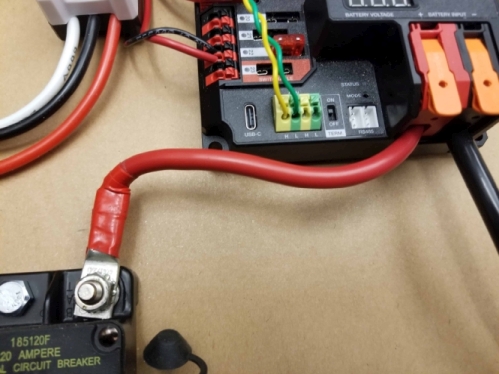
WPILib's example shows a main breaker and distribution hub. A real team's disconnect must be identified and accessible under the applicable rules; the photograph is not an isolation procedure. WPILib wiring guide, FIRST and WPILib contributors, CC BY 4.0; GPS metadata removed.
Practice an inspection mindset
Use the official game manual for the applicable season and its current team updates. As an example, the 2026 manual's section 9 addresses inspection and eligibility; rule I106 describes presenting the robot powered off, pneumatics unpressurized and other stored energy in a low-energy state, with specific exceptions for required checks. Other seasons may differ. Event inspectors and the Lead Robot Inspector make the applicable inspection decisions; ask them when a rule or modification is unclear.
Create a team inspection packet with the current checklist, a versioned robot configuration, a list of materials and electrical devices, and people who can safely demonstrate required functions. Plan access to the main disconnect and inspection points. After a repair or configuration change, check the current reinspection rules before the next match; do not assume an earlier pass covers every change. The 2026 manual's section 9 includes reinspection requirements and exceptions.
Worked scenario: An intake stalls during a test. The team disables, controls power and other stored energy, keeps hands clear, and follows its service procedure before examining the jam. A student notes the conditions and asks a mentor to inspect the mechanism. Only after the area is clear and the team has agreed on a controlled test does the designated operator re-enable. This is an example workflow, not a substitute for the site's rules or procedures.
Try it: Walk through a stationary robot with a mentor. Identify three stored-energy or motion hazards, how each is controlled, and who can authorize a test. Find the current manual's inspection and reinspection sections. Describe what changes to your team's robot might require asking an inspector before competing.