
SubsystemIOSim: a model with explicit assumptions
Prerequisites: IO interfaces, velocity and sample periods. Time: 45 minutes. Outcome: explain the difference between deterministic model behavior and evidence about a physical robot.
An IOSim implements the same interface as real IO, but calculates input values from a model. In the runnable RollerIOTraining.RollerIOSim, the stored voltage is the previous control interval's input. On updateInputs() the model advances exactly 0.02 s and returns a new velocity and applied voltage. The educational equation is dv/dt = (10 V − v) / 0.20 s, where v is rad/s, V is volts, and 10 has units (rad/s)/V. This is an invented first-order model, not a measured Team 1257 mechanism. Its exact constant-input update is:
v_next = v + (10 * voltage - v) * (1 - exp(-dt / 0.20))
If v = 0, voltage = 10 V, and dt = 0.02 s, the next velocity is about 9.516 rad/s. The example clamps requested voltage to ±12 V and rejects non-finite requests. It assumes ideal voltage application, fixed time steps, no battery sag, noise, friction change, mechanical limits, or hardware communication. It advances when updateInputs() is called; calling it twice advances two steps. Production code should define which loop owns simulation advancement and avoid advancing a plant both there and in simulationPeriodic().
Read and calculate a step
This is the actual simulation implementation from the starter; the interface and Inputs record are on the previous page:
public static final class RollerIOSim implements RollerIO {
    private double velocity;
    private double volts;

    @Override public Inputs updateInputs() {
        velocity += (10.0 * volts - velocity)
                * (1.0 - Math.exp(-DT_SECONDS / 0.20));
        return new Inputs(velocity, volts);
    }

    @Override public void setVoltage(double requested) {
        if (!Double.isFinite(requested))
            throw new IllegalArgumentException("voltage must be finite");
        volts = Math.max(-12.0, Math.min(12.0, requested));
    }
}
The surrounding class declares DT_SECONDS = 0.02. The following are calculated values from the example's 100 rad/s target, zero initial state and proportional gain 0.1. The appliedVolts column is the voltage used during the interval ending at the sample; the control calculation then supplies the following interval's voltage.
periodic call |
Sampled velocity (rad/s) | Sampled applied voltage (V) | Next requested voltage (V) |
|---|---|---|---|
| 1 | 0.000 | 0.000 | 10.000 |
| 2 | 9.516 | 10.000 | 9.048 |
| 3 | 17.221 | 9.048 | 8.278 |
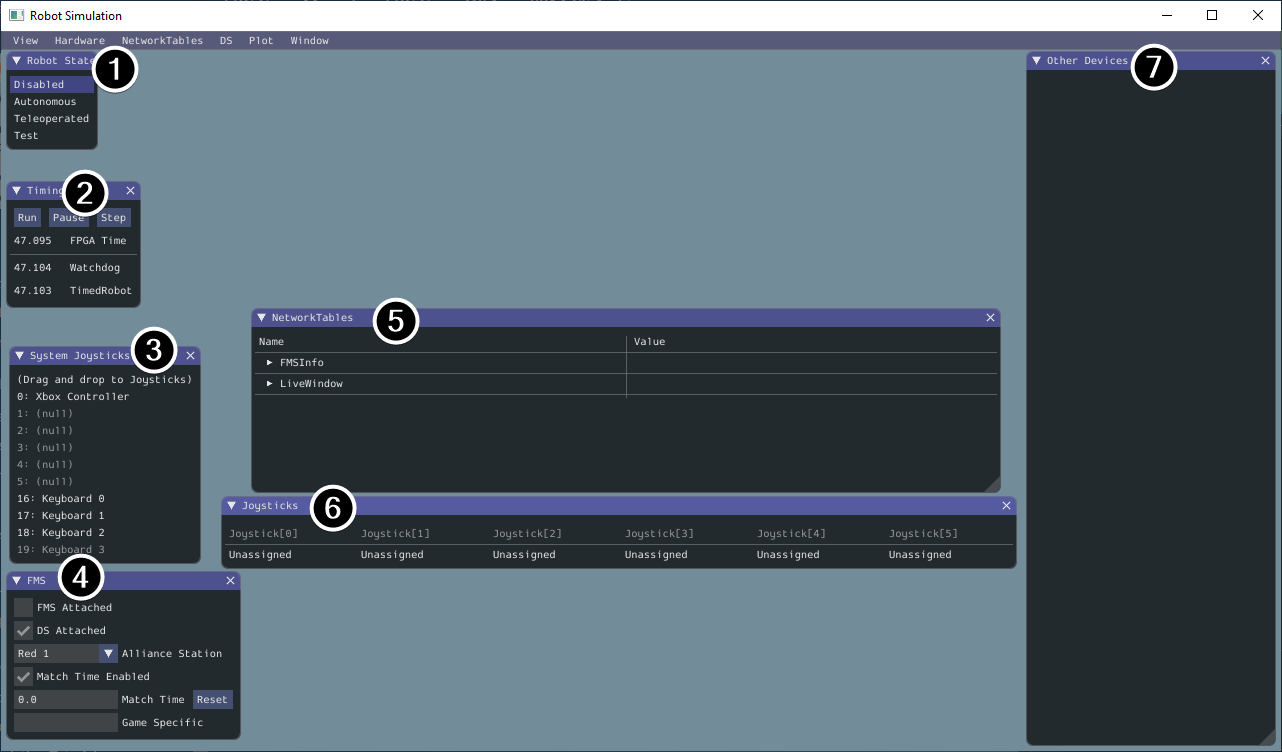
FIRST and WPILib contributors, WPILib Robot Simulation, CC BY 4.0. This is a documentation example, not a screenshot of the roller test above.
Compare the actual team simulator
The pinned HopperIntakeIOSim constructs WPILib FlywheelSim using a motor and constants and advances it by 0.02 seconds in updateInputs. It populates leader voltage and velocity. Inspect the inputs interface: other fields exist but this implementation does not populate all of them. Default values are not simulated measurements. Check actual motor count, gearing, inertia, sensor units, and intended stop behavior in the project's code; do not infer physical accuracy from the class name.
WPILib also offers plant and device simulation APIs. Depending on the design, simulation code can advance a physics model and then inject sensor readings for subsequent control loops. Choose one integration location, define timing and initial conditions, and keep hardware-only API calls out of a simulation-only implementation. A fixed time step and fixed inputs make this small example repeatable, but deterministic code is not automatically accurate physics.
Exercise
Run ./gradlew test --tests frc.robot.ArchitectureLessonsTest in examples/robot-starter. The repeatability test runs two plants with equivalent clamped voltages; the ordering test checks the 0 V first sample and computed second sample. Predict the next sample for −10 V from rest: about −9.516 rad/s. Change the sample period only as a deliberate experiment and recompute the expected value; the fixed-period test should fail until its expectations are reconsidered.
Troubleshooting: no velocity change suggests no voltage was commanded or no update occurred; twice the expected motion suggests the plant is being advanced twice; a sensor that never disconnects may simply be missing from the model. Simulation success does not establish wiring, CAN configuration or safe physical operation. Sources: WPILib physics simulation, device simulation, and the pinned team files above. Next: logging and replay.