
Logged inputs, outputs and replay
Prerequisites: IO interfaces, simulation IO, and logging. Time: 45 minutes. Outcome: identify which data must be captured to reproduce a decision and explain the order of an AdvantageKit loop.
A log input is an observation entering the decision: sensor values, operator input, dashboard settings, network observations and time sources all matter. An output can be a requested voltage, state, error or computed setpoint. Recording an output is useful for diagnosis but cannot replace a missing input. Replaying a log means running code against recorded inputs; it is different from a physics simulation that generates new observations from a model. A real IO implementation should not be created during replay.
For the AdvantageKit IO pattern, the documented loop is:
io.updateInputs(inputs);                 // hardware or simulation fills the cache
Logger.processInputs("Roller", inputs);  // record it, or populate it from replay
// Only now read inputs and perform the subsystem's decision.
This is an architecture excerpt, not a standalone class. In replay, processInputs can replace values with recorded values; doing control calculations before that call uses the wrong sample. Read the same cached values for the rest of the cycle. The team’s pinned HopperIntake.periodic shows updateInputs, then Logger.processInputs, then connection and current processing. The project pins AdvantageKit 26.0.0 in its vendordep; this course's minimal starter does not include AdvantageKit.
RollerIOTraining uses an observer so its JUnit test can verify which immutable sample was published. It demonstrates ordering but does not implement replay, AdvantageKit logging, timestamps, or a real motor. For actual replay, follow the version-matched AdvantageKit configuration and logging setup. AdvantageKit's logging APIs are documented as main-thread-only; unsynchronized extra threads and unlogged randomness, files, dashboard or network values can make decisions differ. A log cannot reconstruct an input it never recorded. Even perfect decision replay does not establish what a modified command would physically do.
Compare one loop in both examples
The following illustrative AdvantageKit excerpt shows the documented ordering. It requires the team's generated inputs class, configured logger and matching AdvantageKit dependency; it is not compiled in the minimal starter.
io.updateInputs(inputs);                  // obtain the current device/model sample
Logger.processInputs("Roller", inputs);   // record, or replace with replayed sample
boolean connected = inputs.connected;    // use the post-process sample
// Decide and send an output using connected and other sampled values.
Compare that with the actual starter excerpt below. inputObserver receives a record for a unit test, but cannot replace it with logged data. Thus the two lines teach similar ordering, not equivalent replay capability.
Inputs inputs = io.updateInputs();
inputObserver.accept(inputs);
io.setVoltage(0.1 * (targetRadPerSec - inputs.velocityRadPerSec()));
For the first two cycles in the simulation test, the observer receives (0 rad/s, 0 V) and then approximately (9.516 rad/s, 10 V). It never receives the new request as though it were an earlier measurement. If the desired target, enable state or clock changes a decision, capture or deterministically provide that input in a real replay architecture too.
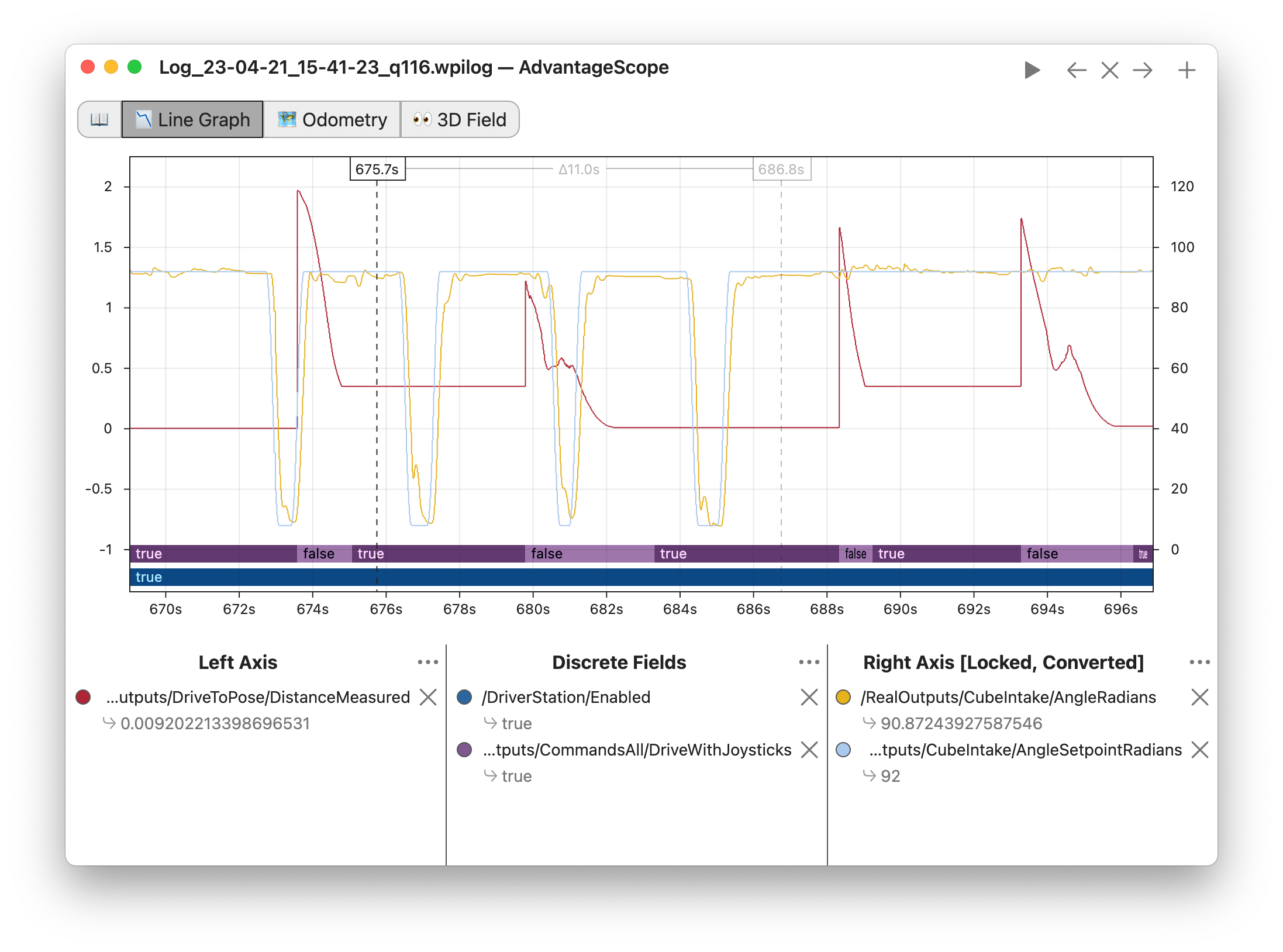
FIRST and WPILib contributors, WPILib plotting guide, CC BY 4.0. This separate documentation example is not the team's 2024 recording.
Exercise
Use the real 2024 log investigation. Identify one recorded input and timestamp, then name an output or test condition that is missing. The provided excerpt includes battery voltage and a module velocity but does not establish cause, robot displacement or a 2026 configuration. Trace how a logged velocity would be processed before a control decision in the example above. If a replay differs from the original, compare code revision, configuration, loop timing and all inputs before interpreting the difference as a control improvement.
Sources: AdvantageKit IO interfaces, dashboard inputs, nondeterministic sources and multithreading. Next: interpolation tables.