
Program differential and swerve drive
Team 254's 2022 binder, pages 13–19, describes an MK4i swerve drivetrain (E22-254-BINDER); Team 1678's 2026 robot page describes MK5n swerve (E26-1678-ROBOT). The research concepts also propose differential drive where an existing simpler base suits the job; those are unbuilt choices, not claims that the cited robots used differential drive or that one drive type won a match.
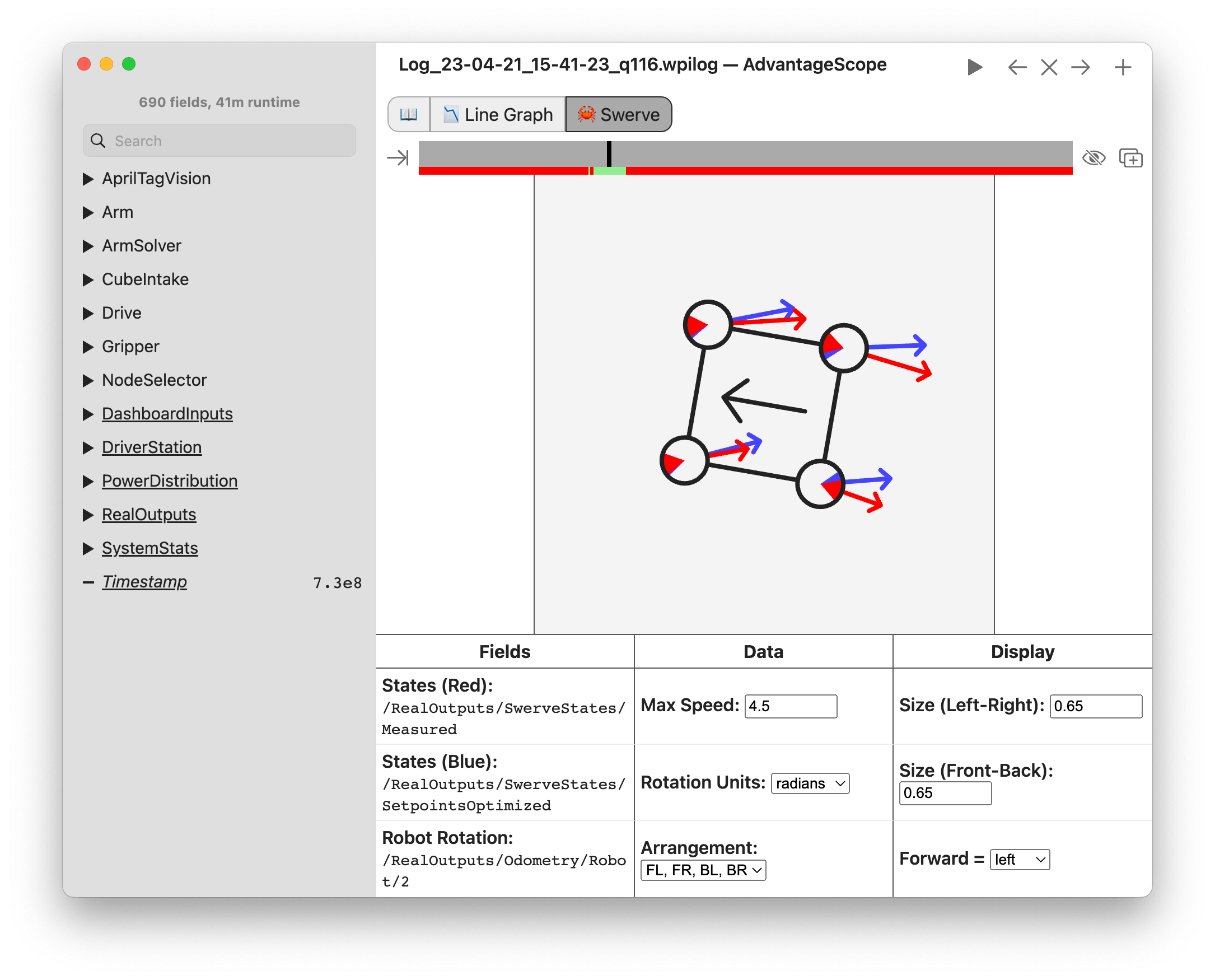
In this separate WPILib documentation example, red and blue arrows show measured and optimized setpoint states; it is not a log from either team-season above. Confirm module order and coordinate frame before interpreting a display. WPILib swerve kinematics, FIRST and WPILib contributors, CC BY 4.0.
Translate a motion request
With differential drive, software controls left and right wheel velocities; turning requires a speed difference, and ideal sideways translation is unavailable. With swerve, each module has a steering angle and drive speed, permitting translation and rotation together within physical limits. Both need motor control, measured wheel distance/speed, a gyro heading, consistent signs and stop behavior. Swerve adds steering absolute/relative encoders, module ordering, offsets and calibration. A wrong module order can make correct-looking math command the wrong corner.
Use metres, metres/second, radians and radians/second consistently. With WPILib's +x forward, +y left, positive counterclockwise convention, field-relative requests must be transformed using the estimated robot heading. At +90° heading, field-forward corresponds to robot-right. A stale or unzeroed heading changes the answer. WPILib swerve kinematics describes the geometry; the swerve lab provides a simplified interactive model.
Illustrative pseudocode — not executable:
validate heading, wheel/module health and enabled state
if field_relative: robot_speeds = rotate(field_speeds, -heading)
if differential: reject unsupported lateral request; solve left/right speeds
if swerve: solve speed + angle for each known module location
constrain achievable speeds; send ordered outputs
update odometry from measured sensors; log request, measurements and quality
Wheel odometry can drift or slip. Vision may correct an estimator if the pose, frame, capture timestamp and uncertainty are suitable; a close simulated trace is not independent ground truth. Autonomous adds an initial pose, path frame, trajectory constraints, cancellation and a recovery route for missed acquisition. Refer to the Team 1257 2026 code walkthrough for a concrete pinned system.
Exercise
Predict pure forward motion and pure rotation before running the lab. Verify each swerve module's direction and compare measured versus requested states, then intentionally reverse the assumed gyro sign in a model and describe the field-relative error. Inject a stale gyro and ensure the intended fallback is explicit. Simulated kinematics do not demonstrate traction, collision avoidance, mechanical alignment or hardware safety.
Predict, experiment, explain
Predict: If a field-forward request is made with the robot at +90° heading, which robot-relative direction is required? What happens to outputs when heading data becomes stale?
Experiment: Enable and request motion; change the forward, sideways and rotation speed inputs and inspect requested motion and state. Compare holonomic mode with the differential toggle: the same lateral request moves the holonomic model but is discarded by the differential model, while forward and turning requests remain available. The demonstration does not supply a field-frame selector; use the separate swerve lab for the heading transform. Make the required sensor stale and watch the fault and outputs. Clear the condition, release request and reset before trying again.
Explain: Compare field-relative and robot-relative requests and identify the gate that stopped motion. This browser model illustrates the decision flow; it does not execute team Java, model traction or establish odometry accuracy. For individual module vectors, use the separate swerve kinematics lab.
Compare the source: Team 2910 2025 SwerveSubsystem.java. The source applies alliance-dependent signs, scales velocities and makes field/robot frame conversions with a skew compensation factor. The demo adapts this idea and does not implement the source method.